Concrete Block Making Machines: Guide to Processes, Types and Uses
Concrete block making machines are used to manufacture concrete masonry units with consistent shapes, dimensions, and material composition.
These machines combine cement, aggregates, water, and other permitted materials before forming the mixture inside moulds under controlled pressure or vibration. Concrete blocks are widely used in walls, partitions, foundations, boundary structures, paving applications, and other forms of construction. Modern concrete block making machines range from manually controlled equipment to automated production lines with computerized controls.
Understanding how these machines work helps explain how concrete blocks are produced on a larger scale. Machine selection depends on the required block type, production capacity, raw materials, mould configuration, available space, and quality-control requirements.
Context
What Are Concrete Block Making Machines?
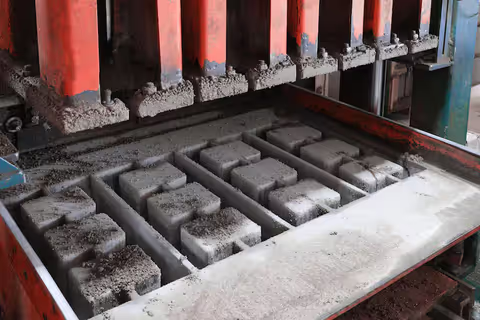
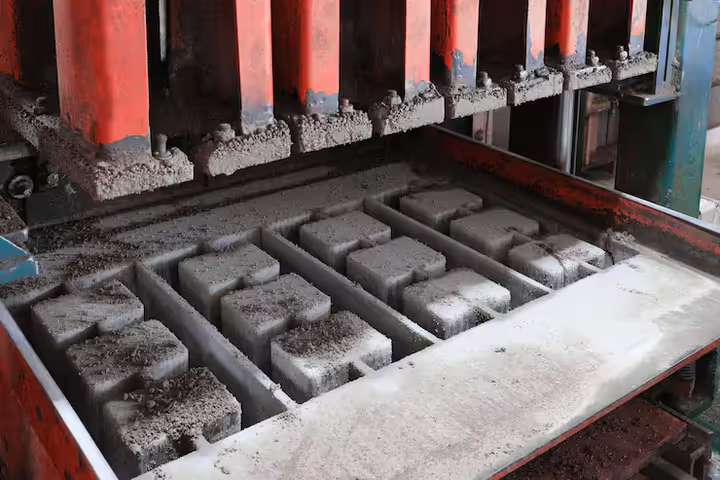
Concrete block making machines are mechanical systems designed to shape a prepared concrete mixture into blocks. Depending on the machine design, the mixture is placed into moulds and compacted through hydraulic pressure, mechanical pressure, vibration, or a combination of these methods.
After moulding, the blocks are removed from the mould and transferred to an area where they can undergo curing. Proper curing allows cement hydration to continue and helps the blocks develop their required mechanical properties.
A typical production arrangement may contain several connected stages:
Raw material storage for cement and aggregates
Batching and proportioning equipment
Concrete mixers
Block moulding equipment
Pallet or product transfer systems
Curing areas or chambers
Handling and stacking equipment
Quality-control instruments
How Concrete Blocks Developed
Concrete masonry has been used for many decades as an alternative to traditional masonry materials. Early production methods depended heavily on manual moulding, while later equipment introduced mechanical compaction and vibration.
As construction activity expanded, manufacturers developed machines capable of producing multiple blocks during one moulding cycle. Modern systems can integrate batching, mixing, mould changes, automated transfer, and production monitoring.
Main Types of Machines
Concrete block making machines can be classified according to their operating method and level of automation.
Manual and semi-automatic machines generally require more operator involvement during material feeding, moulding, product transfer, or stacking. Automatic machines integrate more stages through mechanical, hydraulic, pneumatic, or electronic controls.
Common categories include:
Hydraulic block making machines
Vibro-compaction machines
Semi-automatic block machines
Automatic block production lines
Interlocking block machines
Paver block machines
Hollow block machines
Solid block machines
The mould determines the shape and dimensions of the finished product. A single machine may therefore be used for different products when compatible moulds are available.
Importance
Consistent Block Production
Concrete blocks need reasonably consistent dimensions and material characteristics for efficient construction. Machine-controlled moulding can help maintain repeatable geometry by applying a defined forming process.
Consistency is important because variations in block dimensions can affect wall alignment, joint thickness, material usage, and installation time.
Material Management
Concrete block production involves several raw materials, including cement, sand, aggregates, water, and sometimes mineral additions or approved admixtures. Controlled batching helps maintain the intended mixture proportions.
The exact mixture depends on the block type, required strength, density, environmental conditions, and applicable technical specifications. Material selection should therefore be based on engineering requirements rather than machine capacity alone.
Construction Applications
Concrete blocks are used across residential, commercial, industrial, and infrastructure projects. Typical applications include:
External and internal walls
Partition walls
Boundary walls
Utility structures
Landscaping elements
Paving and pedestrian areas
Masonry construction
Hollow blocks can reduce the amount of concrete used within the unit while also creating spaces that may accommodate reinforcement or building systems where the design permits.
Production Planning
The output of a concrete block making machine depends on several factors rather than machine specifications alone. Mould configuration, cycle time, mixture preparation, curing arrangements, operator procedures, and material handling all influence practical production.
The following table provides a general comparison of machine categories.
| Machine category | Operator involvement | Typical application | Main characteristic |
|---|---|---|---|
| Manual | High | Small-scale production | Simple operating arrangement |
| Semi-automatic | Moderate | Regular block production | Partial mechanical control |
| Automatic | Lower | Higher-volume production | Integrated control systems |
| Hydraulic | Moderate to high | Various block types | Hydraulic forming force |
| Vibro-compaction | Moderate | Blocks and pavers | Vibration-based compaction |
These categories can overlap because a machine may combine hydraulic pressure, vibration, and automated controls.
Recent Updates
Automation and Digital Controls
Recent developments in concrete block making machines increasingly involve automation and electronic monitoring. Programmable controllers can coordinate mixing, moulding, transfer, and other production stages.
Digital interfaces can display operating parameters such as cycle information, production counts, alarms, and selected machine settings. These features can make process monitoring more structured, although actual capabilities differ between equipment designs.
Improved Material Handling
Material handling has also become an important area of development. Conveyor systems, automated pallet movement, stackers, and transfer mechanisms can reduce repetitive manual handling within production areas.
Some modern production lines connect raw-material preparation, block forming, curing, and stacking into a coordinated sequence. The degree of integration depends on factory layout and production requirements.
Energy and Resource Efficiency
Manufacturers are increasingly examining electricity consumption, water use, material utilization, and equipment operating efficiency. More precise controls can help reduce unnecessary machine movement and improve coordination between production stages.
Water management is particularly relevant because concrete production requires controlled moisture levels, while curing can require additional water depending on the method used.
Digital Quality Monitoring
Digital measurement tools are increasingly used alongside traditional inspection methods. Production records can include batch information, mould configuration, cycle information, and quality-test results.
Some facilities also use sensors to monitor equipment conditions. Such systems can support preventive maintenance planning by identifying unusual vibration, temperature, pressure, or operating patterns.
Flexible Mould Systems
Modern concrete block making machines may be designed around interchangeable moulds. This allows one production system to manufacture different block profiles when the machine and mould specifications are compatible.
This approach is relevant where a facility needs multiple product dimensions without installing a completely separate forming system for each type.
Laws or Policies
Indian Standards for Concrete Masonry
In India, concrete masonry products are influenced by technical standards issued through the Bureau of Indian Standards (BIS). Standards covering concrete masonry units address characteristics such as dimensions, strength, density, water absorption, and related testing requirements.
IS 2185 is an important reference for concrete masonry units, with different parts addressing categories such as concrete hollow and solid blocks. Applicable requirements should be checked against the specific product being manufactured.
Construction and Safety Requirements
Concrete block production involves machinery, electrical equipment, lifting systems, rotating equipment, dust, cement handling, and material movement. Workplace safety requirements therefore form an important part of factory planning.
The Occupational Safety, Health and Working Conditions Code, 2020 provides a broader framework for occupational safety and working conditions in India, subject to its implementation and applicable rules. State-level requirements and factory regulations may also apply.
Environmental Considerations
Concrete manufacturing can generate dust, wastewater, noise, and solid residues. Environmental requirements can vary according to the scale and location of the facility.
The Central Pollution Control Board (CPCB) and relevant State Pollution Control Boards provide environmental frameworks and guidance for industrial activities. Facilities should verify applicable permissions, emission controls, waste handling requirements, and local rules before production begins.
Quality Testing
Testing may include dimensional checks, compressive strength testing, water absorption measurement, density assessment, and visual inspection, depending on the applicable product standard.
Laboratory equipment should be selected according to the relevant Indian Standard and testing procedure. Product requirements can differ between hollow blocks, solid blocks, paving units, and other concrete products.
Tools and Resources
Production Planning Tools
A production worksheet can be used to record raw-material quantities, batch proportions, mould type, cycle information, curing conditions, and inspection results. Digital spreadsheets can make it easier to compare production records over time.
Quality-Control Equipment
Common tools used around concrete block production include:
Weighing scales for material measurement
Moisture measurement instruments
Concrete compression testing equipment
Vernier calipers or dimensional gauges
Measuring tapes and straightedges
Density measurement equipment
Curing temperature and humidity monitoring instruments
The exact testing equipment should correspond to the applicable product specification.
Technical Standards and Government Resources
Useful information can be obtained from the Bureau of Indian Standards, Central Pollution Control Board, State Pollution Control Boards, and relevant government construction authorities.
Manufacturers and plant operators can also consult equipment manuals, technical drawings, mould specifications, electrical documentation, and preventive maintenance schedules. These documents help establish operating procedures specific to a particular machine.
FAQs
What are concrete block making machines used for?
Concrete block making machines are used to mould concrete mixtures into solid blocks, hollow blocks, pavers, and other masonry products. The machine applies controlled forming and compaction methods to produce units with defined shapes and dimensions.
How do concrete block making machines work?
A typical process begins with batching and mixing cement, aggregates, and water. The mixture enters a mould, where pressure, vibration, or both compact it into the required shape. The formed block is then transferred for curing.
What materials are used with concrete block making machines?
Common materials include cement, sand, coarse or fine aggregates, and water. Depending on the product specification, approved mineral additions or chemical admixtures may also be used.
Are automatic concrete block making machines different from semi-automatic machines?
Yes. Automatic systems generally coordinate more production stages through programmed controls, while semi-automatic systems require operators to perform some production or material-handling steps. The exact division of tasks varies by machine design.
Which standards apply to concrete blocks in India?
Relevant Indian Standards depend on the type of concrete masonry unit. IS 2185 is a major reference for concrete masonry units, while other standards may apply to specific products, testing methods, or construction applications.
Conclusion
Concrete block making machines provide a structured method for producing masonry units through controlled mixing, moulding, compaction, and curing processes. Machine categories range from manually controlled equipment to automated production systems with digital monitoring and material-handling functions. Recent developments have focused on automation, process monitoring, resource management, flexible mould systems, and equipment diagnostics. In India, technical standards, workplace rules, and environmental requirements influence how concrete block production facilities are planned and operated.