Vibrating Screens: Discover Screening Technology, Deck Design, Material Separation and Efficiency Factors
A vibrating screen is a mechanical screening machine used to separate bulk materials according to particle size.
It uses a vibrating motion to move material across a screen surface, allowing smaller particles to pass through openings while larger particles continue toward another discharge point. Vibrating screens are widely used in mining, quarrying, construction, recycling, aggregate processing, asphalt plants, and mineral processing.
The basic idea is simple: a mixture of particles is placed on a screen with openings of a selected size, and controlled vibration helps the material move across the surface. The process separates the material into different size ranges without requiring manual sorting.
How Vibrating Screens Developed
Mechanical screening has been used for many years to separate minerals, aggregates, grains, and other bulk materials. Earlier screening systems relied on simple shaking or mechanical movement, while modern vibrating screens use carefully designed vibration mechanisms, structural frames, screening media, and drive systems.
Modern equipment can be configured with different screen sizes, deck arrangements, vibration patterns, and screening surfaces. The selection depends on the material being processed, required particle sizes, feed rate, moisture level, and plant layout.
Main Components
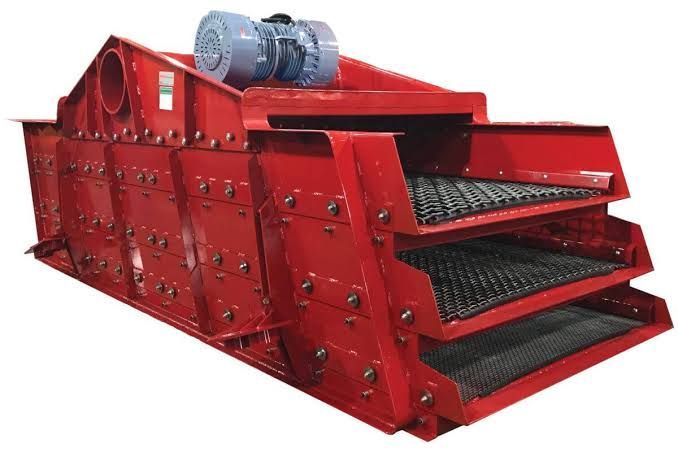
A typical vibrating screen contains several important components. The screen deck provides the surface through which material is separated, while the vibrating mechanism generates the movement required for screening.
Other components can include:
Screen panels or mesh
Vibrating mechanism
Drive motor
Bearings
Springs or other suspension components
Support frame
Feed chute
Discharge chutes
Protective guards
The arrangement varies according to the type and intended application of the screen.
Importance
Why Vibrating Screens Matter
Vibrating screens are important because many industrial processes require materials to be separated into specific size ranges. In aggregate production, for example, crushed stone may need to be divided into several fractions before being used in construction mixtures.
In mining operations, screening can separate mineral-bearing material from particles of different sizes. Recycling plants can also use screens to sort processed materials before additional stages of separation or treatment.
The screening process can influence the consistency of material entering later stages. If particles are not separated as intended, downstream crushers, conveyors, mixers, or storage systems may receive material outside their specified size range.
Common Applications
Vibrating screens are used across several industries:
Quarrying and aggregate production
Mining and mineral processing
Asphalt mixing plants
Concrete aggregate preparation
Construction material processing
Coal handling
Recycling operations
Manufactured sand production
Soil and gravel processing
Different applications require different screen designs. A screen processing damp material may require a different configuration from one handling dry, free-flowing aggregate.
Types of Vibrating Screens
There are several common vibrating screen configurations. Inclined screens are positioned at an angle and use gravity together with vibration to move material across the deck. Horizontal screens operate with a more level screening surface and can be used where particular material-flow characteristics are required.
Linear vibrating screens generally move material along a defined path, while circular-motion screens create a different movement pattern. Multi-deck screens contain several screening surfaces so that material can be separated into multiple size ranges during one processing stage.
| Screen type | General characteristic | Typical application |
|---|---|---|
| Inclined vibrating screen | Angled screening surface | Aggregate and quarry processing |
| Horizontal vibrating screen | Relatively level deck | Mineral and aggregate separation |
| Linear vibrating screen | Linear material movement | Industrial screening |
| Circular-motion screen | Circular or elliptical movement | Quarry and mineral applications |
| Multi-deck screen | Several screening surfaces | Multiple size classifications |
The actual performance of any configuration depends on factors such as material properties, screen opening, feed distribution, vibration parameters, and operating conditions.
Recent Updates
Digital Monitoring
From 2024 through 2026, developments in industrial screening have increasingly included digital monitoring and equipment-condition tracking. Sensors can be used to observe vibration, bearing temperature, motor behavior, and other operating parameters.
When connected to a plant control system, monitoring data can provide operators with information about changing equipment conditions. This can help distinguish normal operating patterns from unusual vibration or temperature behavior.
Improved Screening Media
Screening media has also continued to develop. Depending on the application, equipment may use woven wire mesh, perforated plates, rubber panels, polyurethane panels, or other materials.
The choice of screening surface depends on particle size, material abrasiveness, moisture, temperature, and required separation. Modular screen panels can also simplify replacement of individual sections when wear occurs.
Automation and Process Control
Modern processing plants increasingly connect vibrating screens with conveyors, crushers, feeders, and other equipment through centralized control systems. Automated monitoring can track material flow and equipment status across several stages.
Variable-speed drives and electronic controls may also be used in some installations. These technologies allow operating conditions to be adjusted according to the plant's process requirements, although the available control features differ between systems.
Energy and Noise Considerations
Industrial operators are also paying attention to electrical consumption, mechanical efficiency, and workplace noise. Vibrating screens contain moving masses and rotating components, so their design and installation can influence vibration transmission to surrounding structures.
Proper mounting, alignment, isolation, and structural design are therefore relevant to equipment operation and workplace conditions.
Laws or Policies
Requirements in India
In India, vibrating screens used in industrial facilities can be affected by workplace safety, environmental, electrical, and factory regulations. The exact requirements depend on the industry, facility location, equipment configuration, materials handled, and applicable regulatory classification.
The Factories Act framework and occupational safety provisions provide a basis for workplace protection. Applicable rules may address machinery guarding, worker access, electrical safety, noise, dust, and maintenance procedures.
Environmental Considerations
Vibrating screens can generate airborne dust when processing dry materials such as crushed stone, minerals, sand, and construction aggregates. Industrial facilities may therefore use enclosed transfer points, water-suppression arrangements where appropriate, extraction systems, and dust-collection equipment.
The Central Pollution Control Board and State Pollution Control Boards have roles in environmental regulation in India. Specific requirements vary according to the plant, material, location, and applicable permissions.
Machinery Safety
Moving screen components, rotating shafts, drive systems, and material falling from elevated areas create potential hazards. Guards, controlled access, emergency stopping arrangements, appropriate protective equipment, and established inspection procedures are commonly used to reduce exposure to these hazards.
Electrical isolation is particularly important before maintenance or inspection involving moving machinery. Procedures should follow the equipment documentation and applicable workplace rules.
Tools and Resources
Screening Calculations
Engineers and plant operators can use screening calculations to estimate how factors such as feed rate, screen area, particle size distribution, moisture, and deck configuration may affect the process.
Material testing can provide information about particle-size distribution. Sieve analysis is a commonly used laboratory method for determining the proportion of particles within different size ranges.
Monitoring Equipment
Several instruments can be used to monitor vibrating screens. Vibration sensors can record movement patterns, while temperature sensors can monitor bearings or other selected components.
Other tools can measure electrical parameters such as motor current and voltage. Inspection records can then be compared with historical readings to identify changes in operating conditions.
Technical Resources
Useful reference materials can come from organizations such as the Bureau of Indian Standards, Central Pollution Control Board, State Pollution Control Boards, and international engineering organizations. Equipment manuals and technical drawings are also important because screen dimensions, operating limits, lubrication requirements, and inspection procedures vary between machines.
A basic inspection record can include screen-panel condition, spring condition, bearing temperature, drive alignment, vibration behavior, motor condition, structural fasteners, and material buildup.
FAQs
What is a vibrating screen used for?
A vibrating screen is used to separate bulk materials according to particle size. Common applications include aggregate processing, mining, quarrying, recycling, asphalt plants, and construction-material processing.
How does a vibrating screen work?
Material is fed onto a vibrating screen surface. Controlled vibration moves the material across the deck, allowing particles smaller than the screen openings to pass through while larger particles continue toward a separate discharge point.
What are the main types of vibrating screens?
Common types include inclined screens, horizontal screens, linear vibrating screens, circular-motion screens, and multi-deck screens. Their characteristics differ according to the motion pattern, deck arrangement, and material-flow requirements.
What factors affect vibrating screen performance?
Important factors include feed rate, particle-size distribution, moisture content, screen opening, deck area, vibration characteristics, material shape, and how evenly material is distributed across the screen surface.
How is a vibrating screen maintained?
Maintenance generally involves inspecting screen panels, bearings, springs, drive components, structural connections, guards, and other moving parts. Monitoring vibration and temperature can also help identify changes in equipment condition.
Conclusion
A vibrating screen is a mechanical separation system that classifies bulk materials according to particle size through controlled vibration. It is used across industries including mining, quarrying, construction, recycling, and asphalt production. Modern systems increasingly incorporate digital monitoring, improved screening media, automation, and condition tracking. Safe operation also depends on appropriate guarding, dust control, electrical precautions, inspection procedures, and compliance with applicable industrial regulations.